Synthetic tri-receptor agonist peptide
A 39-amino-acid investigational peptide with a lipid modification studied for prolonged receptor exposure.

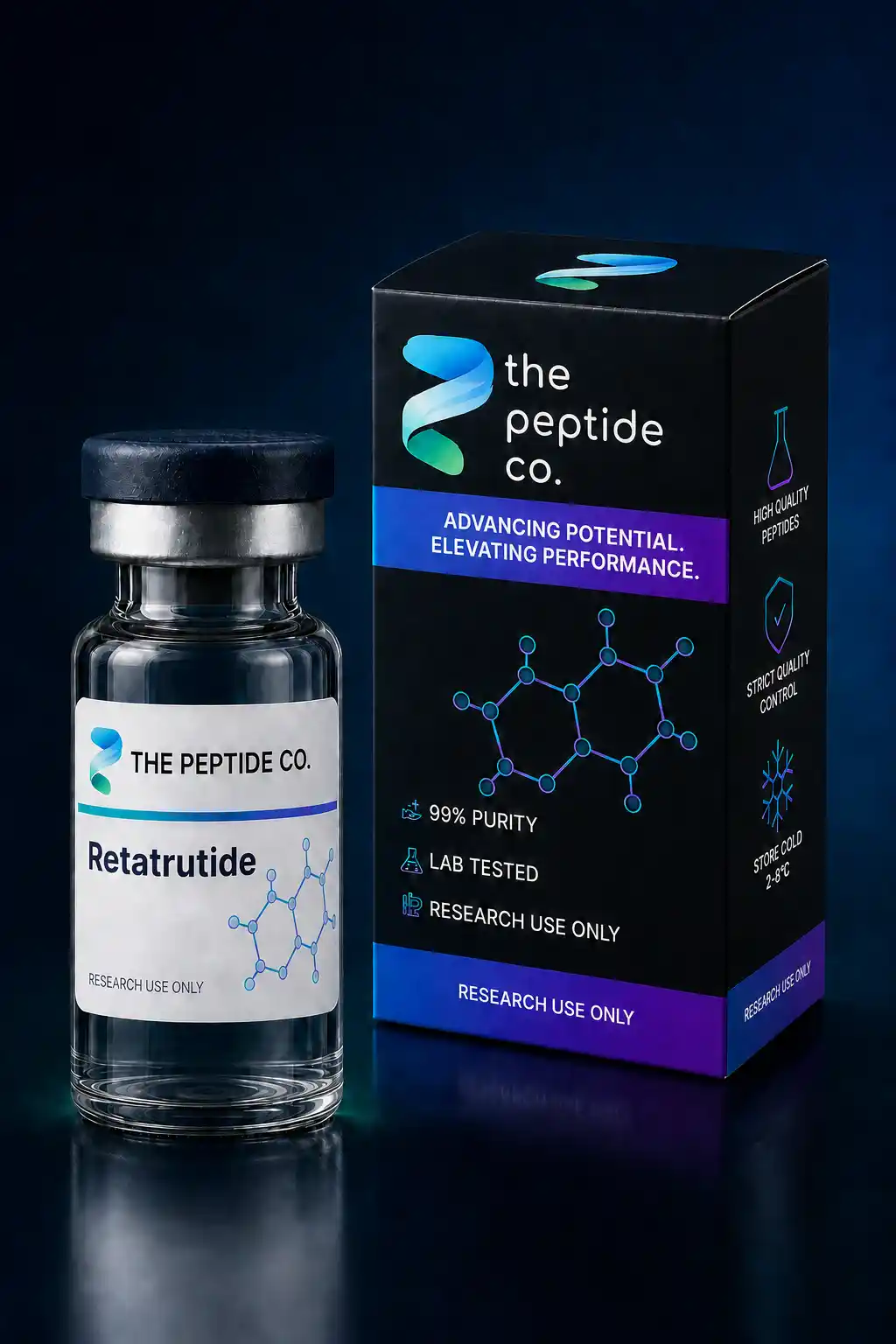
METABOLIC / RESEARCH COMPOUND
5+ vials: 10% off
Analytical results apply to a specific sample, batch and test method. Ask about the exact lot being offered; do not assume a generic purity figure or test panel applies to every batch.
Understand Batch Test Reports ↗For laboratory research use only. Not for human consumption. No treatment or self-administration guidance is provided.
A 39-amino-acid investigational peptide studied as a triple GLP-1, GIP and glucagon receptor agonist. Pep-Pedia centres its profile on weight, glycaemic and cardiovascular research while noting that development and safety evaluation remain ongoing.
A 39-amino-acid investigational peptide with a lipid modification studied for prolonged receptor exposure.
An investigational triple-receptor peptide, with listed research presentations, prices and compound specifications.
Explore receptor targets and downstream signalling studied for this compound.
Activates an incretin receptor involved in glucose and appetite signalling.
View primary studyEngages the second incretin pathway through GIPR.
View primary studyAdds glucagon signalling to the two incretin pathways.
View primary studyAll three receptors connect to intracellular second-messenger signalling.
View primary studyExpand each group. Categories follow the linked Pep-Pedia source profile. Labels describe relative research emphasis and are not clinical efficacy grades.
Clinical trials demonstrate 17.5% at 24 weeks and 24.2% at 48 weeks - highest recorded for any obesity medication in development
Continuous weight loss throughout trials with no plateau reached at 48 weeks, suggesting greater long-term potential than current therapies
Addresses obesity through appetite suppression, increased energy expenditure, and improved metabolic efficiency via three hormone pathways
HbA1c reductions up to 2.16% with 82% of participants achieving target levels below 6.5% - exceeding dual agonist performance
Glucose-dependent insulin secretion and glucagon suppression provide balanced glycemic control with minimal hypoglycemia risk
Marked improvements in insulin sensitivity with potential for significant reduction in exogenous insulin requirements
Non-HDL cholesterol reductions up to 26.9%, triglyceride reductions up to 40.6%, and ApoB reductions up to 24.2%
Consistent decreases in both systolic and diastolic blood pressure across clinical trials, supporting cardiovascular risk reduction
Up to 82% reduction in liver fat with normalization in 90% of participants, addressing MASLD and reducing cardiovascular risk
Pep-Pedia community poll distributions. Every response option returned for each displayed question is shown.
Anonymous self-reporting is subject to selection bias and is not clinical evidence. Percentages describe community responses and may not total exactly 100% because of rounding. Snapshot captured 2026-10-16; the source refreshes in the background.
Research context belongs beside—not above—the safety and evidence boundary.
* Source context: Pep-Pedia research profile ↗. This catalogue uses a research-only summary and does not reproduce protocol or self-use instructions.
Weeks 1–2 · appetite may decrease while mild digestive effects can appear as the body adjusts to triple-receptor activity
Weeks 2–4 · food cravings and portion sizes may fall, with early weight changes reported in trials
Weeks 4–8 · appetite control and weight change may become more noticeable; glucose measures may also improve in studied diabetic populations
Weeks 8–16 · trials report broader weight, energy-expenditure and metabolic changes
Weeks 16–24 · larger weight changes and improvements in cardiovascular and liver-fat markers have been reported
Weeks 24–48 · longer studies assess maximum weight response, wider metabolic effects and whether benefits are sustained
Study type is part of the product information. Laboratory, animal, observational and controlled human findings are not interchangeable.
Clinical trials demonstrate 17.5% at 24 weeks and 24.2% at 48 weeks - highest recorded for any obesity medication in development
HbA1c reductions up to 2.16% with 82% of participants achieving target levels below 6.5% - exceeding dual agonist performance
Non-HDL cholesterol reductions up to 26.9%, triglyceride reductions up to 40.6%, and ApoB reductions up to 24.2%
Curated starting points, not a systematic review, comparative ranking or batch-test record. Follow the source for the full methods and results.
| Source | Study model | Measured topic and limitations |
|---|---|---|
| Retatrutide phase 2 study ↗Jastreboff et al. · 2023 · PMID 37366315 | Randomised phase 2 trial · 338 adults · 48 weeks | Measures body-weight change and adverse events in the specified trial population. Read the trial formulation, population, comparator and follow-up; the publication does not certify catalogue material. |
Retatrutide identity and research evidence · Retatrutide vs Tirzepatide compared · Is Retatrutide available in India? · Retatrutide vs Tirzepatide · Research availability in India · Batch COA checklist · Presentation and blend labels · Publisher and source policy
The currently listed INR prices are 10 mg: ₹5,500; 20 mg: ₹8,500; 30 mg: ₹12,000; 40 mg: ₹14,000; Premium Segment: ₹15,000. The prices above are for the labelled research presentations. Confirm availability, delivery charges and the final order total before payment.
Reta is a common abbreviation for Retatrutide, and LY3437943 is its development code. Match the full material name, labelled presentation and batch identity when comparing product records. A shared name alone does not verify the contents of a vial.
Reta; LY3437943 are names used in material searches. A receptor-research peptide investigated at GLP-1, GIP and glucagon receptors. Match the full label, form and batch documents; an alias alone does not authenticate a product.
A receptor-research peptide investigated at GLP-1, GIP and glucagon receptors. A dual GIP/GLP-1 receptor research material. This catalogue presentation is distinct from a finished prescription medicine. Compare identity, component amounts and the actual study model. Shared research topics do not establish equivalent effects.
Delivery enquiries are welcome for these cities and other Indian destinations, subject to the actual PIN code. Standard delivery: ₹150, estimated 3–5 days. Express delivery: ₹350, estimated 2–3 days. Cash on delivery adds ₹150. Confirm PIN-code serviceability and the delivery estimate before ordering.
Returns and refunds are available for products damaged on arrival or if purity is below 99%. Retain the order reference, packaging and relevant batch records; contact the team to confirm the claim process.
Select the labelled presentation and quantity, review the cart, then send the order enquiry on WhatsApp. Share your Indian PIN code so the team can confirm stock, serviceability, delivery charges and the final INR total before payment. The listed material is for laboratory research only, not for human consumption.
Use the batch COA request link on this page and specify the selected presentation. Ask the team to match available documentation to the current batch and confirm delivery to your Indian PIN code before payment. Compare the report identity, test method and measured result with the material offered.
Standard delivery across India costs ₹150 and usually takes 3–5 days. Express delivery costs ₹350 and usually takes 2–3 days. Cash on delivery is available for an extra ₹150. The team confirms serviceability for your PIN code and the final total on WhatsApp before dispatch.
Yes. The Peptide Co. ships from Bengaluru to eligible PIN codes across India, including Mumbai, Delhi NCR, Bengaluru (Bangalore), Hyderabad, Chennai, Pune, Kolkata and Ahmedabad. Share your PIN code on WhatsApp to confirm serviceability and the delivery estimate for your address.
Retatrutide is also known as Reta, LY3437943. These names describe the same listing on this page; always match the labelled identity and batch documentation rather than relying on a name alone.
Retatrutide (LY3437943) is an investigational triple GIP, GLP-1 and glucagon receptor agonist; Tirzepatide (LY3298176) is a dual GIP and GLP-1 receptor agonist. Our Retatrutide vs Tirzepatide guide compares identity, receptor targets, research status and label checks. Read the guide at thepeptideco.in/guides/retatrutide-vs-tirzepatide.
As of 1 November 2026, this page shows 5 listed presentations for Retatrutide, and prices on the page are read from the live catalogue each time it loads. Current availability is shown with the listed sizes. Your final total is confirmed on WhatsApp.
Retatrutide is classified as synthetic tri-receptor agonist peptide. A 39-amino-acid investigational peptide with a lipid modification studied for prolonged receptor exposure.
Its principal research areas are GIP, GLP-1 and glucagon receptor activity, energy-balance models, metabolic research. These describe experimental topics, not guaranteed outcomes or approved indications.
10 mg · 20 mg · 30 mg · 40 mg · Premium Segment lyophilized research material in a sealed glass vial. Appearance: White to off-white lyophilized powder. Always compare the received vial with its lot-specific documentation.
Store sealed, away from heat, light and moisture; follow the batch documentation for temperature limits.
Investigational; not approved for routine human use. This catalogue presentation is restricted to laboratory research material and does not provide dosing, treatment or self-administration guidance.