Copper-binding tripeptide complex
Glycyl-L-histidyl-L-lysine coordinated with copper, producing the characteristic blue appearance.

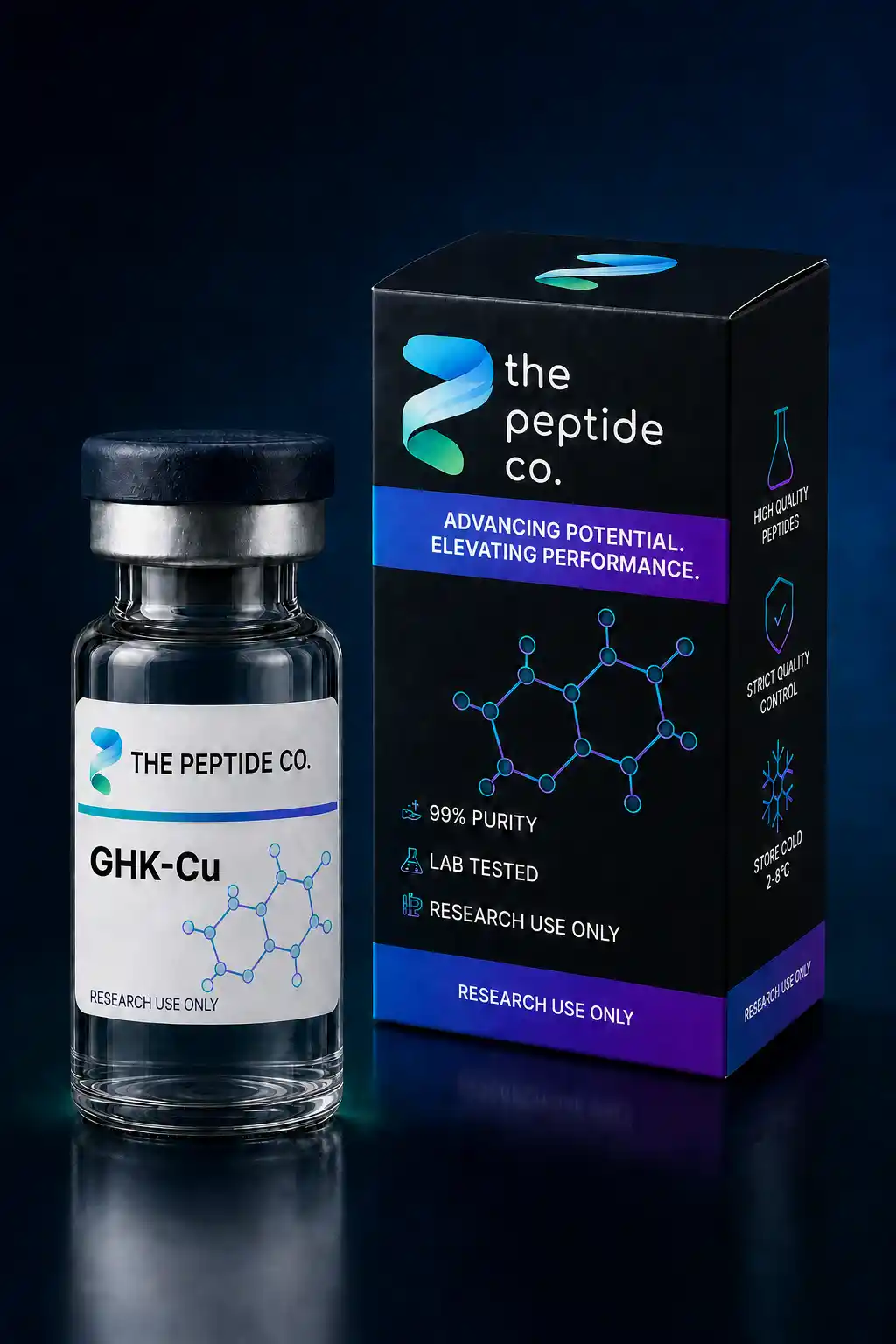
AESTHETICS / RESEARCH COMPOUND
5+ vials: 10% off
Analytical results apply to a specific sample, batch and test method. Ask about the exact lot being offered; do not assume a generic purity figure or test panel applies to every batch.
Understand Batch Test Reports ↗For laboratory research use only. Not for human consumption. No treatment or self-administration guidance is provided.
GHK-Cu is a naturally occurring copper-binding tripeptide studied in extracellular-matrix, skin, follicle and inflammatory models.
Glycyl-L-histidyl-L-lysine coordinated with copper, producing the characteristic blue appearance.
Copper tripeptide-1 (GHK-Cu), offered in specified research presentations with detailed compound information.
Explore receptor targets and downstream signalling studied for this compound.
GHK binds copper ions in a tripeptide complex.
View primary studyChanges collagen production in cultured fibroblasts.
View primary studyModulates MMP-2 expression during matrix remodelling.
View primary studyAlso changes inhibitors that constrain matrix breakdown.
View primary studyExpand each group. Categories follow the linked Pep-Pedia source profile. Labels describe relative research emphasis and are not clinical efficacy grades.
Increases type I and III collagen production by 70% for improved skin firmness, reduced wrinkle depth, and enhanced skin texture
Stimulates elastin synthesis for improved skin elasticity and resilience, reducing sagging and improving skin bounce-back
Strengthens the skin's protective barrier, improves moisture retention, and reduces transepidermal water loss
Promotes hair follicle enlargement and extends the anagen (growth) phase, leading to thicker, fuller hair
Improves scalp circulation, reduces inflammation, and creates optimal conditions for hair growth
Increases hair shaft diameter and overall density, with visible improvements in hair fullness over 12-16 weeks
Reduces redness, irritation, and sensitivity through anti-inflammatory mechanisms and improved skin barrier function
Protects skin from environmental damage and oxidative stress through powerful antioxidant properties
Accelerates minor wound healing and reduces post-inflammatory hyperpigmentation for clearer skin
Promotes angiogenesis and may improve microcirculation through blood vessel formation and reduced blood viscosity
Pep-Pedia community poll distributions. Every response option returned for each displayed question is shown.
Anonymous self-reporting is subject to selection bias and is not clinical evidence. Percentages describe community responses and may not total exactly 100% because of rounding. Snapshot captured 2026-10-16; the source refreshes in the background.
Research context belongs beside—not above—the safety and evidence boundary.
* Source context: Pep-Pedia research profile ↗. This catalogue uses a research-only summary and does not reproduce protocol or self-use instructions.
Weeks 1–2 · skin hydration and texture may begin to change
Weeks 3–4 · fine-line appearance and skin smoothness may improve
Weeks 6–8 · firmness and elasticity are commonly assessed
Weeks 8–12 · changes in tone and clarity may become more visible
Weeks 6–12 · early hair-related changes may begin to appear
Study type is part of the product information. Laboratory, animal, observational and controlled human findings are not interchangeable.
Increases type I and III collagen production by 70% for improved skin firmness, reduced wrinkle depth, and enhanced skin texture
Promotes hair follicle enlargement and extends the anagen (growth) phase, leading to thicker, fuller hair
Reduces redness, irritation, and sensitivity through anti-inflammatory mechanisms and improved skin barrier function
Curated starting points, not a systematic review, comparative ranking or batch-test record. Follow the source for the full methods and results.
| Source | Study model | Measured topic and limitations |
|---|---|---|
| GHK-Cu collagen synthesis in fibroblasts ↗Maquart et al. · 1988 · PMID 3169264 | Fibroblast cultures | Measures collagen synthesis after exposure to the copper-tripeptide complex. The indexed abstract does not provide a universal 70% collagen figure. Such a percentage needs its exact experiment and measurement, not this general citation. |
GHK-Cu identity and research evidence · GHK-Cu in the KLOW and GLOW blends · Batch COA checklist · Presentation and blend labels · Publisher and source policy
The currently listed INR prices are 50 mg: ₹4,800; 100 mg: ₹7,500; Premium Segment: ₹10,000. The prices above are for the labelled research presentations. Confirm availability, delivery charges and the final order total before payment.
No. This is a laboratory research material record, not a finished cosmetic serum. Compare the copper complex, labelled peptide amount and batch documentation; a serum concentration or bottle volume is not directly comparable with the milligrams in a research vial.
copper tripeptide-1; GHK copper complex are names used in material searches. A copper-binding tripeptide complex. A research vial is distinct from a finished cosmetic serum. Match the full label, form and batch documents; an alias alone does not authenticate a product.
A copper-binding tripeptide complex. A research vial is distinct from a finished cosmetic serum. A research blend listing associated with BPC-157, TB-500 and GHK-Cu. Its total mass and component ratio must be read from the actual presentation. Compare identity, component amounts and the actual study model. Shared research topics do not establish equivalent effects.
Delivery enquiries are welcome for these cities and other Indian destinations, subject to the actual PIN code. Standard delivery: ₹150, estimated 3–5 days. Express delivery: ₹350, estimated 2–3 days. Cash on delivery adds ₹150. Confirm PIN-code serviceability and the delivery estimate before ordering.
Returns and refunds are available for products damaged on arrival or if purity is below 99%. Retain the order reference, packaging and relevant batch records; contact the team to confirm the claim process.
Select the labelled presentation and quantity, review the cart, then send the order enquiry on WhatsApp. Share your Indian PIN code so the team can confirm stock, serviceability, delivery charges and the final INR total before payment. The listed material is for laboratory research only, not for human consumption.
Use the batch COA request link on this page and specify the selected presentation. Ask the team to match available documentation to the current batch and confirm delivery to your Indian PIN code before payment. Compare the report identity, test method and measured result with the material offered.
Standard delivery across India costs ₹150 and usually takes 3–5 days. Express delivery costs ₹350 and usually takes 2–3 days. Cash on delivery is available for an extra ₹150. The team confirms serviceability for your PIN code and the final total on WhatsApp before dispatch.
Yes. The Peptide Co. ships from Bengaluru to eligible PIN codes across India, including Mumbai, Delhi NCR, Bengaluru (Bangalore), Hyderabad, Chennai, Pune, Kolkata and Ahmedabad. Share your PIN code on WhatsApp to confirm serviceability and the delivery estimate for your address.
GHK-Cu is also known as copper tripeptide-1, GHK copper complex. These names describe the same listing on this page; always match the labelled identity and batch documentation rather than relying on a name alone.
Yes. GLOW combines GHK-Cu with BPC-157 and TB-500, and KLOW adds KPV as a fourth constituent. This listing is single-compound GHK-Cu. Our KLOW vs GLOW guide explains how to compare blend constituents with single vials. Read the guide at thepeptideco.in/guides/klow-vs-glow.
As of 1 November 2026, this page shows 3 listed presentations for GHK-Cu, and prices on the page are read from the live catalogue each time it loads. Current availability is shown with the listed sizes. Your final total is confirmed on WhatsApp.
GHK-Cu is classified as copper-binding tripeptide complex. Glycyl-L-histidyl-L-lysine coordinated with copper, producing the characteristic blue appearance.
Its principal research areas are copper-peptide signalling, extracellular matrix, skin and hair models. These describe experimental topics, not guaranteed outcomes or approved indications.
50 mg · 100 mg · Premium Segment lyophilized research material in a sealed glass vial. Appearance: Blue lyophilized powder. Always compare the received vial with its lot-specific documentation.
Keep sealed, dry and protected from light/moisture. Store at 2–8°C short-term and ≤−20°C long-term unless the batch documentation states otherwise.
Common in topical research; injectable human use is not established. This catalogue presentation is restricted to laboratory research material and does not provide dosing, treatment or self-administration guidance.